UNM Statistics Consulting Clinic
Statistics Consulting Clinic
The Statistics Consulting Clinic (SCC) is an internal statistical consulting service of The University of New Mexico. Staffed by statistics faculty and advanced statistics graduate students from the Department of Mathematics and Statistics, the service is offered without charge to faculty, staff, and student clients at UNM in support of their academic research and other statistical needs. The goals of the SCC are to promote scientific collaboration between disciplines, enhance the quality of research at UNM, and improve the education of UNM students. This service is funded by the College of Arts and Sciences and the Department of Mathematics and Statistics.
Contacts and Hours
- Location: SMLC 358
- Hours: Request Appointment for appointment, Provide Feedback after consultation
- Summer: CLOSED
- Consultant: Haiyang Zhu is a PhD Candidate in Statistics.
- Director: Prof. Ronald Christensen is a Distinguished Professor in the Department of Mathematics and Statistics, UNM.
How the SCC adds value
The SCC helps with more than the analysis, offering service for every step of a project, including:
- Problem Formulation
- Experimental Design and Sample-Size Determination
- Selection of Statistical Models
- Advice on Statistical Modeling and Help with Interpreting Output
- Advice on Choice of Statistical Software
- Programming Assistance with Statistical Analysis
- Explanation of Statistical Content of Papers in Your Discipline
- Paragraphs on `Statistical Methods' for Grant Proposals
- Help with Reviewer's Comments and Resubmissions
Expectations
A typical consulting experience follows these steps, and may iterate several times.
- Complete a request for statistical assistance. (Available during academic semesters, closed during the summer.)
- A consultant will typically contact you by email or phone within 24 hours.
- An appointment will be set in the clinic office where you'll help the consultant understand your problem, questions, and data.
- The consultant may be able to provide immediate help, or may need to do some research to provide a better solution.
- A follow-up meeting is typical as, together, you both converge on a strategy that best helps to answer your questions.
- Note: The SCC staff should not be regarded as research assistants. Our role is to help choose appropriate methods and help enable you to produce your results (tables, plots, etc.) yourself. Do not expect SCC staff to produce results for you. We reserve the right to refuse service for any reason.
Statistical Software
SCC staff are available to answer questions concerning statistical packages, and have access to R, SAS, SPSS, Minitab, and others. Please understand that the number of software packages and variety of platforms are many and we cannot possibly be experts on everything. Even so, we will endeavor to answer questions regarding your particular software needs.
UNM SCC Services
Below is a detailed discussion of the services we provide. There are currently no fees for service. In order to hire more graduate consultants to make a greater positive impact on the UNM research community we are considering strategies for more funding, such as having the SCC being included as a budget line item on research grants (note that upwards of two-thirds of our hours are spent on grant-funded research). Some discussion below represents developing ideas regarding funding possibilities.
Students
The SCC is a free service for UNM students. We can help provide statistical support for dissertation and thesis work, written reports, and sparingly for upper level courses.
Faculty and staff
The SCC is a free service for UNM faculty and staff.
Grant-funded Collaborators
The SCC believes that developing a collaborative research team of statisticians and investigators is the best strategy for success in original research. We request that you include the Statistics Consulting Clinic as a budget line item in your grant proposals. We are working with the OVPR to develop a rate schedule, etc.
SCC and your Research Grant
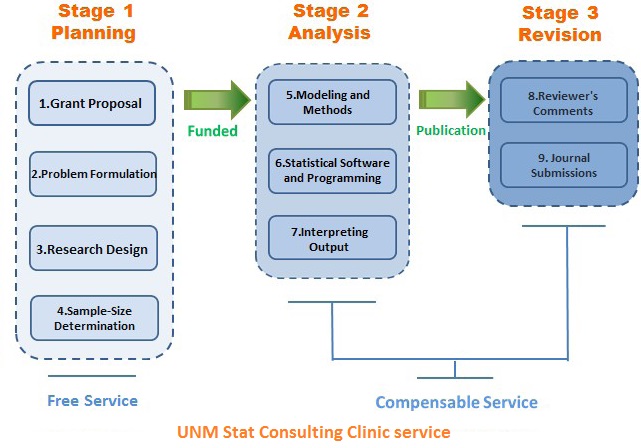
Statistics is indispensable for many scientific projects. Many research proposals can be made more effective with a stronger statistical component. The SCC can strengthen your research work by helping formulate hypotheses, prescribe a experimental design, determine sample size requirements, suggest data collection methodology, determine sensible methods of analysis, and help interpret results. Our aim is to help UNM Principal Investigators be more competitive and succeed in grant application and research publication. Our services can be divided into three stages: project planning, analysis, and revision.
Stage 1
Collaborating with the SCC in the early stages of a research project is the best way to ensure high-quality, meaningful research. At this stage we can help with writing the grant proposal, including problem formulation, research/experimental design, and sample size determination.
1. Grant Proposal
Normally, multi-project awards support a multidisciplinary research team or group of investigators that focuses on a common research topic. They generally fund shared resources and facilities across multiple smaller research projects, and a biostatistics, data management, and/or bioinformatics core facility is often part of these proposals. The SCC consultants can help with the preparation of grant proposals. Statistical consultants are available to discuss the proposed designs of experiments and surveys, sample size calculations and the suggested statistical analyses. They can review statistical methodologies sections that are to be included in the proposals.
2. Problem Formulation
Problem formulation is a crucial step in any research project. Problem formulation requires creativity and experience and is often more important in avoiding a problematic state than problem-solving later. The SCC consultants can help you with:
- Helping formulate and write research questions
- Defining hypotheses
- Developing the associated data analysis
- Determining a power analysis to increase the probability that meaningful effects will be detected
- Suggesting meaningful summaries and plots to help tell your story
Properly written research questions and hypotheses smooth the way for subsequent discussion of statistical methods and power analysis in your methods section, and helps you and your grant reviewers feel confident that your research strategy can answer your questions.
3. Research Design
The research design structures the project and provides a plan for how the central research questions can be answered by relating the major components: sample and treatment design, measurements, model parameters, etc. The SCC helps you choose the most appropriate design for your research and helps ensure that all elements of your research design contribute to answering your questions. There are many sources to help you start thinking about constructing a research design.
- Identify the problem clearly and justify its selection.
- Review previously published literature dealing with the problem area.
- Clearly and explicitly specify hypotheses central to the problem selected.
- Clearly describe the data which will be necessary for an adequate test of the hypotheses and explain how such data will be obtained.
- Describe the methods of analysis which will be applied to the data in determining whether or not the hypotheses are false.
Good research designs minimize the plausible alternative explanations for the hypothesized cause-effect relationship. By involving the statistician at the early stage, numerous obstacles and pitfalls can be avoided, tine can be saved, and together we can produce a superior finished product.
4. Sample-Size Determination
Given a research design, sample size determination chooses the number of observations or replicates required in your sample to have a given probability of detecting the important effects, under certain assumptions. The sample size is an important feature of any empirical study in which the goal is to make inferences about a population from a sample. In a grant application the sample size proposed for a study is typically determined to achieve a certain statistical power to detect important effects, though sometimes may be largely determined by the expense of data collection. Consider partnering with the SCC to help calculate a minimum appropriate sample size and to understand the sample size calculation methods.
Stage 2
Congratulations, your proposal has been funded! Partner with the SCC to help with the subsequent research process: data modeling, programming, and interpreting results.
5. Modeling and Methods
Use of statistical models has been dominating the analysis strategies in many scientific research areas. A good statistical model can provide understanding of the underlying mechanisms of a data set. Statistical modeling is not just "fitting equations to data," but a description of a system that helps us reason more clearly. Here's what we can do for your research:
- Characterize numerical data to concisely describe the measurements and to help in the development of conceptual models of a system or process
- Help estimate uncertainties in observational data and uncertainties in calculation based on observational data
- Characterize numerical output from mathematical models to help understand the model behavior and to assess the model's ability to simulate important features of the natural system (model validation). Feeding this information back into the model development process will enhance model performance
- Estimate probabilistic future behavior of a system based on past statistical information, a statistical prediction model. This is often a method use in climate prediction.
- Perform extrapolation or interpolation of data based on a linear fit (or some other mathematical fit); they are also good examples of statistical prediction models.
- Estimate input parameters for more complex mathematical models.
- Obtain frequency spectra of observations and model output.
Our analytic goal is to quantify information in an objective and defensible manner, accounting for the role of chance and bias.
6. Statistical Software and Programming
Our statisticians also help implement statistical methodology using one or more of the standard statistical computer programs. We can help with code organization, scripting languages, programming constructs, and naming conventions. We may be able to assist in your research project by actually doing statistical or programming work, data management and/or analysis, scripting, text parsing, and database work. Statistical analysis packages we use include R, SPSS, SAS, and MINITAB.
7. Interpreting Output
Once the data have been analyzed, we interpret the results, translating the statistical notation, jargon, and computer output into clear, meaningful conclusions. We may provide you with a professional, thorough report documenting the statistical methods that are used to substantiate the conclusions that are made. We can help you visualize the results in meaningful, intuitive ways.
Stage 3
Write up the methods and results, etc., submit and resubmit.
8. Reviewer's Comments
We help to address the reviewer's comments and revise your grant or manuscript.
9. Journal Submissions:
When you prepare to publish a scientific research paper, we can help with the statistical literature review and other statistical considerations. You can consider the SCC as a partner in your research. This can range from a simple acknowledgement to co-authorship. Co-authorship is appropriate when the consultant provides significant input to the final research product.
Previous Directors
- S22 - current Prof Ron Christensen
- S21 - F21 Prof. Guoyi Zhang
- S20 - F20 Prof. Yan Lu
- S15 - F19 Prof. James Degnan
- F11 - F14 Prof. Erik Erhardt
- - S11 Prof. Gabriel Huerta
- Created by Prof. Ron Christensen
Previous Student Consultants
- F23 Erin Schwertner-Watson
- S23 Erin Schwertner-Watson
- F22 Erin Schwertner-Watson
- S22 Nikolay Miller
- F21 Nikolay Miller
- S21 Nikolay Miller
- F20 Nikolay Miller
- S20 Xichen Li
- F19 Xichen Li
- S19 Xichen Li
- F18 Xichen Li
- S18 Jared DiDomenico
- F17 Zach Stuart
- S17 Anasatsiia Kim
- F16 Anasatsiia Kim
- S16 John Pesko
- F15 John Pesko
- S15 John Pesko
- F14 John Pesko
- S14 Yonghua Wei
- S14 Maozhen Gong
- F13 Yonghua Wei
- S13 Yan Dong
- F12 Maozhen Gong
- S12 John Pesko (at RWJF)
- S12 Glenn Stark
- S12 Mohammad Hattab
- F11 Glenn Stark
- F11 Mohammad Hattab
- S11
- F10
- S10
- F09
- S09
- F08 Erik Erhardt
- S08
- F07
- S07